
Brown County Arrest Records and Court Charges
Brown County arrest records start on the law-enforcement side. The Brown County Sheriff's Office led by Sheriff John Merchant, Hiawatha Police Department, Horton Police Department, or another agency may make an arrest, and a booking record may then show a booking number, charge text, bond, arresting agency, date, age, sex, and race when released to the public. The Brown County jail roster is the custody-side route, while sheriff report copies and records contacts handle some law-enforcement records.
Court charge records start when the prosecutor files or pursues formal allegations. Brown County's prosecuting office is the Brown County Attorney in the Brown County Courthouse. The official courthouse directory lists County Attorney Kevin Hill at 601 Oregon, Suite 101, Hiawatha, phone 785-740-7401. Peggy Siebenmorgen, Clerk of the District Court, keeps the court case file after charges are filed. The full case file and final outcome belong in Brown County criminal court records, while this page focuses on the charge path after arrest.
Find Brown County Arrest Records
Use different sources for different parts of the record. For current custody, use the Brown County Sheriff's jail roster. For law-enforcement report copies, use the sheriff records channel. For formal charges, use Kansas CaseSearch and the Clerk of the District Court. For active warrants, use the sheriff warrant list and confirm with the District Court Clerk or sheriff. No official Brown County Sheriff's mobile app was located in the inspected sources, so the research does not support an app-only lookup path.
- Check the Brown County Sheriff's jail roster when the question is current custody or booking detail.
- Copy the booking number, charge text, arresting agency, date, and bond shown on the roster.
- Search Kansas CaseSearch by defendant name or case number to find the filed court charges.
- Read each charge count, statute number, amendment, dismissal, plea, or disposition in date order.
- Contact the Clerk of the District Court when the filed charge record is not available remotely.
- Use sheriff records or Brown County KORA channels only for the law-enforcement or county-agency records they control.
The Brown County Sheriff's contact and records information appears in this image from the Brown County Sheriff's Office contact page.
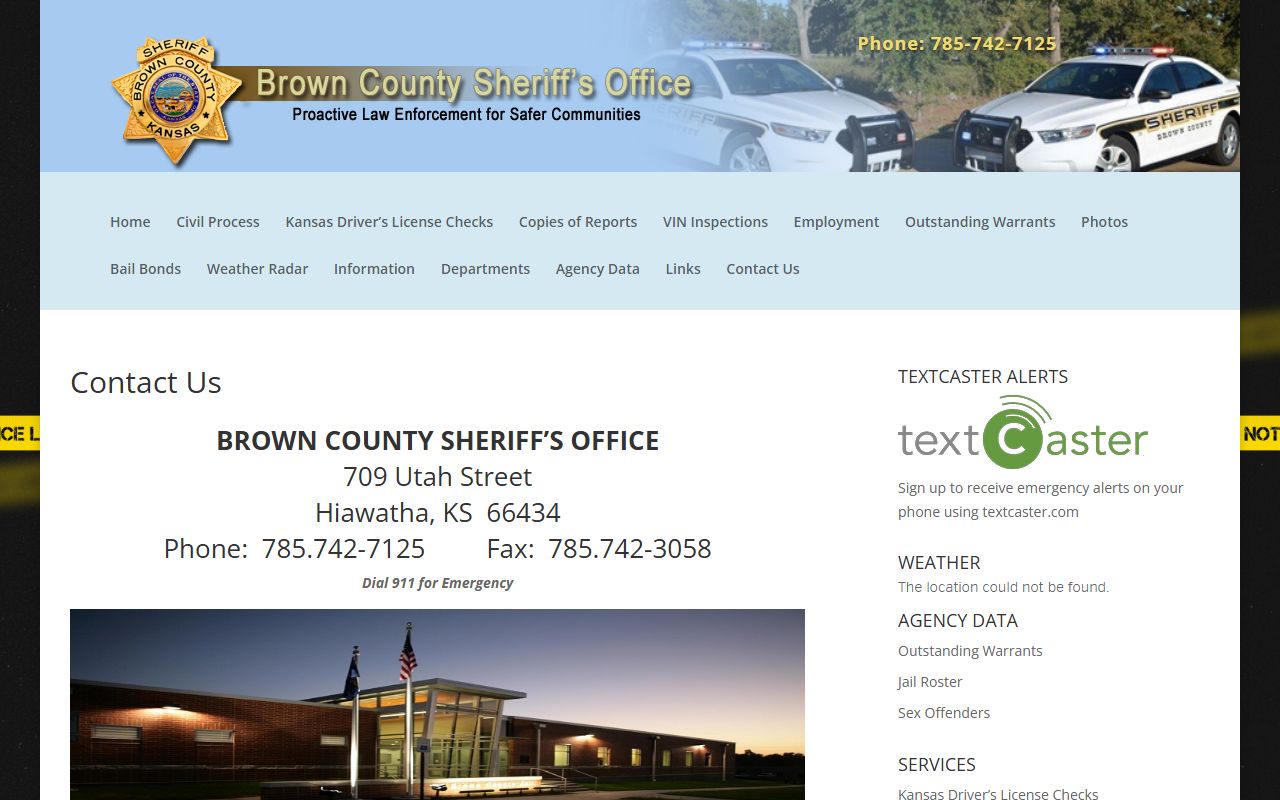
That sheriff route is useful for arrest-side records, while filed charges and court outcomes remain District Court records.
Brown County Charges After Arrest
Charges after arrest can appear in more than one place. A booking charge may be a law-enforcement label used at intake. A filed court charge is the formal allegation the prosecutor brings into court. A later docket entry may show that the charge was amended, reduced, dismissed, or resolved by plea. One arrest can lead to several counts, and each count can have a different status.
| Document | Who Files It | Brown County Use | What It Starts |
|---|---|---|---|
| Complaint | Officer or prosecutor | Common criminal charging document for initiating allegations. | Begins or supports the criminal case record. |
| Information | Prosecutor | Formal prosecutor-filed charge document used in many Kansas criminal cases. | Sets out charges for District Court proceedings. |
| Indictment | Grand jury | Less common than prosecutor-filed charging documents, but possible in serious matters. | Begins prosecution based on grand jury accusation. |
Brown County jail and warrant records show charge examples that include failure to appear, probation violation, criminal threat, disorderly conduct, traffic offense, fraud or insufficient funds check, and possession-related allegations. Those examples show local terminology, but the filed District Court record is the better source for current charge status.
Brown County Charge Status
Charge status changes as a case moves. A pending charge has not reached a final outcome. An amended charge may replace or change the original count. A reduced charge is a less serious or different allegation after plea negotiations or court action. A dismissed charge is not a conviction. Kansas court records may also show diversion, probation violation, failure to appear, or sentencing events tied to the charge path.
| Status | What It Means | How to Read It |
|---|---|---|
| Pending | The allegation remains open. | Look for later plea, hearing, dismissal, or trial entries. |
| Amended | The court charge changed from the original filing. | Compare the old count with the new count and date. |
| Reduced | The charge changed to a lesser or different allegation. | Check whether the reduction is tied to a plea or disposition. |
| Dismissed | The court no longer proceeds on that count. | Do not treat a dismissed charge as a conviction. |
| Diversion | The case may be handled through conditions instead of ordinary conviction. | Review the docket and final entry for completion or revocation. |
| Probation violation | The court alleges noncompliance with probation. | Check whether the violation was proven, dismissed, or resolved. |
Charge vs Conviction
A charge is an allegation. A conviction is a final court result after a guilty plea, no-contest plea accepted by the court, or guilty finding. Brown County arrest records may show a charge at booking before the prosecutor files or changes the court charge. District Court records may later show that one charge was dismissed while another count was resolved by plea. Reading only the first charge line can give the wrong result.
| Point | Charge | Conviction |
|---|---|---|
| Record stage | Arrest, booking, complaint, information, or pending court count. | Final result after plea or finding. |
| Proof level | An accusation or probable-cause-based allegation. | A court outcome entered in the case. |
| Can change | Yes, it can be amended, reduced, added, or dismissed. | Yes, but through appeal, correction, revocation, or expungement routes. |
| Best source | Jail roster, warrant list, charging document, and court docket. | Final District Court disposition and sentencing entries. |
Brown County Charge Codes
Brown County sheriff jail and warrant examples include Kansas statute numbers and short charge labels. Examples in the research include K.S.A. 21-5915(a) failure to appear, 22-3716 probation violation, 21-6203 disorderly conduct, and 21-5415 criminal threat. Serious felony statutes also appear in local jail and warrant data. A charge code points to the legal source for the allegation, but the docket must be checked to learn whether the allegation is pending, amended, dismissed, or resolved.
Sheriff report copies are a separate access channel. The Brown County Sheriff's Office records-copy page says report copies cost $5.50, exact change, during normal business hours. That can help with incident or report records, but it does not replace the filed court charge record. Court charges after arrest are tracked by District Court once the prosecutor files them.
Sheriff report-copy information appears in this image from the Brown County Sheriff's Office report-copy page.
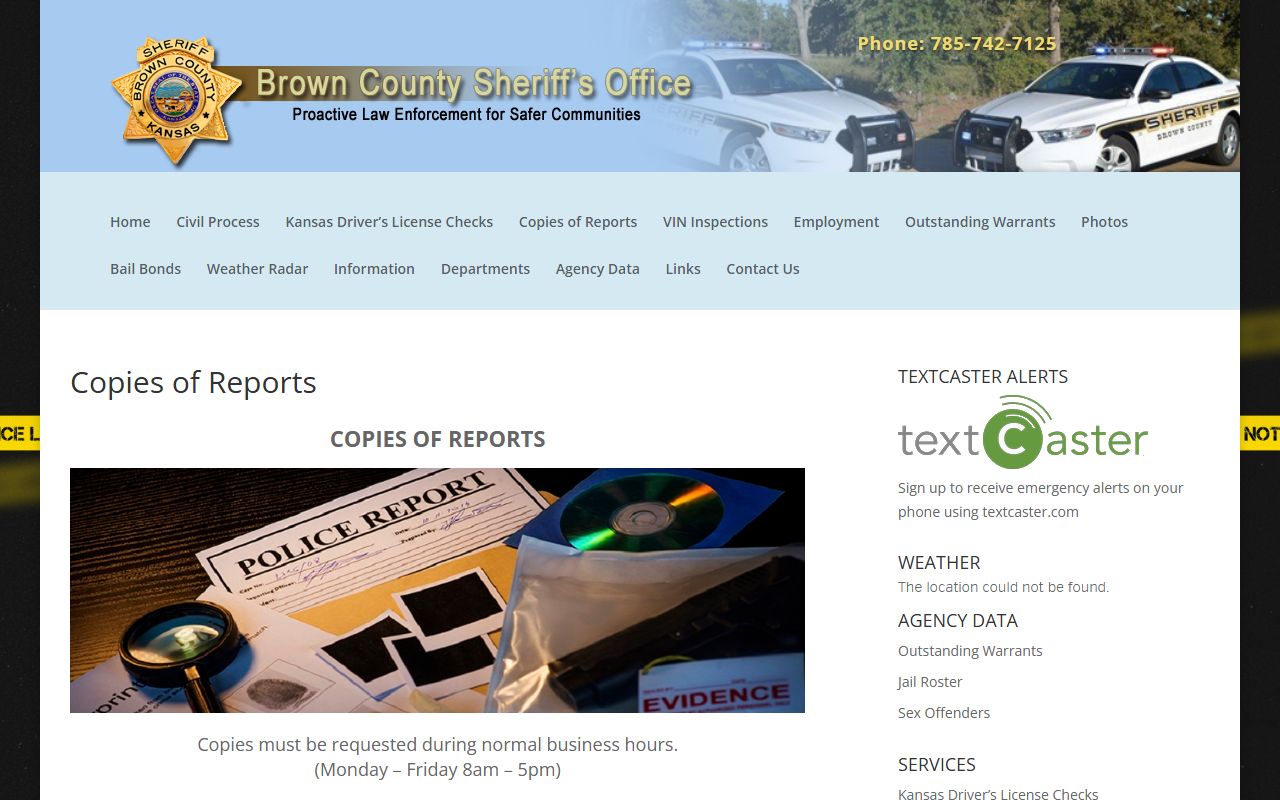
Report copies can explain law-enforcement activity, but the filed charge status belongs in the court record.
Statewide Criminal History Routes
State systems answer questions that the Brown County charge record does not. KDOC KASPER is for state prison and supervision records. The KBI registered offender registry is for registered offender information and includes warnings against misuse. Those systems are not the Brown County jail roster and are not the District Court case file. They may be useful after sentencing or for registry status, but they should not be used alone to decide what charge was filed, dropped, or convicted.
KDOC contact information appears in this image from the Kansas Department of Corrections contacts page.
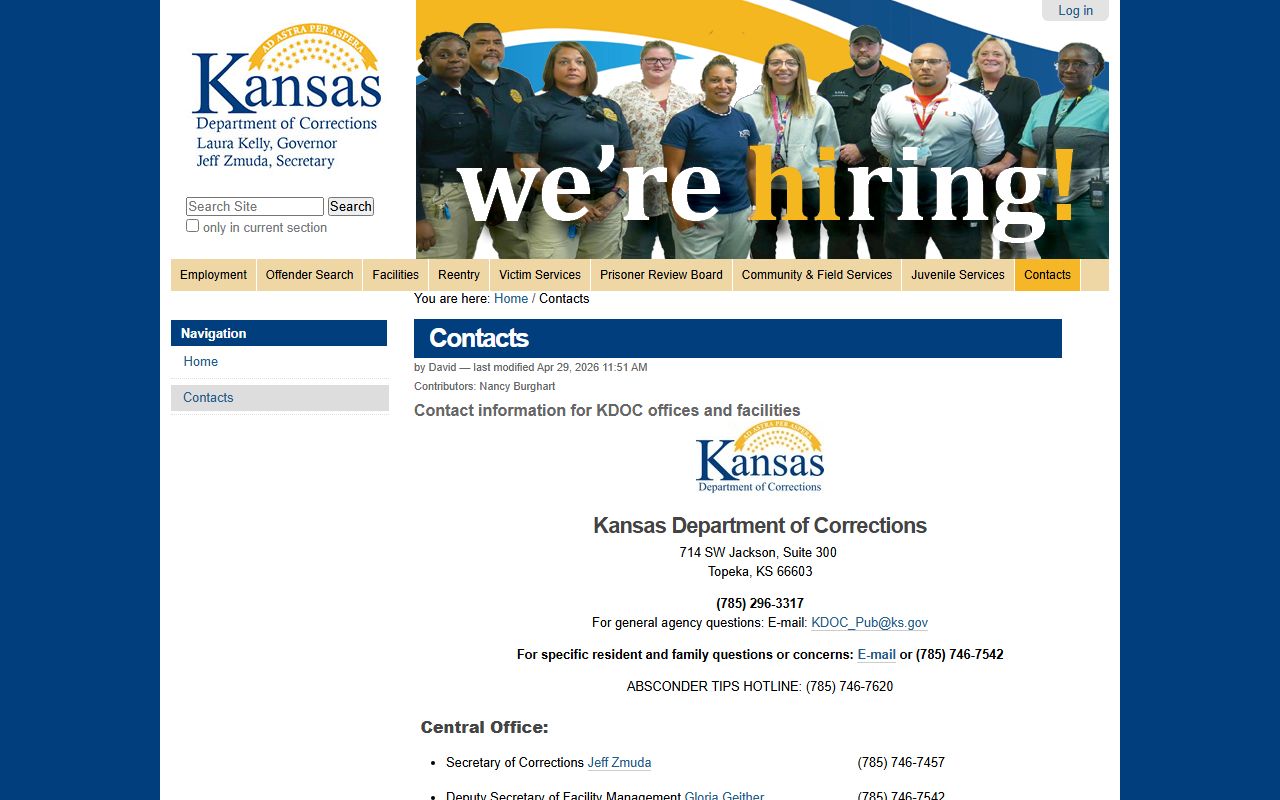
KDOC is a post-sentence or supervision resource, while Brown County court charges are checked through District Court records.
Sealed and Expunged Charges
Kansas law and court rules restrict some arrest and charge records. Juvenile offender records, child-in-need-of-care records, sealed records, adoption files, care-and-treatment matters, and protected personal identifiers are not ordinary public lookup records. Expungement under K.S.A. 21-6614 can apply to many adult convictions, arrest records, and diversion agreements, but eligibility depends on the offense, timing, and case history.
| Point | Sealed | Expunged |
|---|---|---|
| Visibility | Hidden from ordinary public access while sealed. | Public access is limited after a granted petition. |
| How it starts | By court order, statute, rule, or confidential case category. | By petition in the court where the arrest, conviction, or diversion record exists. |
| Effect | The record may still exist for authorized court or agency use. | The event is not erased for every government or legal purpose. |
| Brown County route | Ask the District Court clerk or court for access rules. | Use Kansas Judicial Council forms and file in the proper District Court case. |
Restricted Brown County Charge Records
Public search screens may omit or redact charge records for lawful reasons. A missing record may be sealed, expunged, juvenile, confidential, held in a municipal court, not yet filed, or not remotely available. Kansas Supreme Court Rule 22 governs public electronic access to district and appellate case records. The Kansas Open Records Act is still useful for county agency records, but court records have their own access path through court rules and the Clerk of the District Court.
Note: A booking charge can differ from the formal charge later filed in Brown County District Court.
For urgent warrant or arrest-risk questions, confirm directly with the Brown County Sheriff's Office or the District Court Clerk. Brown County research found no public statewide Kansas warrant search in official sources, and no official Brown County sheriff app in inspected sources. City municipal cases should also be checked with the city court if the District Court search does not show the citation or charge.