
Brown County Probate Records
Probate in Brown County is not assigned to a separate county probate court. It is part of the Brown County District Court, which sits in the 22nd Judicial District and has general trial-court jurisdiction in Kansas. The probate docket can include estates after death, wills, letters testamentary, letters of administration, inventories, creditor claims, accountings, final settlement orders, guardianships, and conservatorships. The same courthouse record system also holds related domestic, civil, criminal, and traffic case records, so the correct case type matters when searching.
The practical office for Brown County probate records is the Clerk of the District Court. The 22nd Judicial District lists the Brown County court at 601 Oregon Street, PO Box 417, Hiawatha, KS 66434-0417, with the clerk phone at 785-742-7481. Brown County's genealogy packet also identifies the Clerk of District Court as the office with probate and court records from early county history. For users who need a copy for estate administration, title work, guardianship proof, or family history, the access path may differ by age and by whether the file is public, sealed, or partly confidential.
Probate Division of District Court
Office: Brown County Clerk of the District Court
601 Oregon Street
PO Box 417
Hiawatha, KS 66434-0417
785-742-7481
Search Brown County Probate Records
Kansas CaseSearch is the first online channel for public District Court case information, including Brown County probate cases that are available for public remote access. The Kansas Judicial Branch explains that district court case information and public case records may be searched online or through courthouse terminals. The former public access portal was replaced by CaseSearch, so Brown County probate searches should use the current statewide tool rather than old portal links.
- Start with Kansas CaseSearch and search by the decedent, protected person, petitioner, or case number if known.
- Use Brown County as the court location when the tool allows a county or court filter.
- Check whether the result is an estate, guardianship, conservatorship, domestic, or civil case before ordering copies.
- If the case is not visible online, ask the Clerk of the District Court about courthouse terminal access or older paper files.
- For certified copies, give the clerk the case number, party name, record type, and delivery method.
Some Brown County probate records may be public in part but not fully viewable from home. Kansas Supreme Court Rule 22 controls public electronic access to district court case records, and sealed cases or sealed documents are not displayed through public portals or courthouse terminals. Inventory, accounting, medical, and protected-person information can raise privacy issues even when a docket entry is public.
The Kansas Revisor page for K.S.A. 59-1507b is a useful source for small-estate probate research.
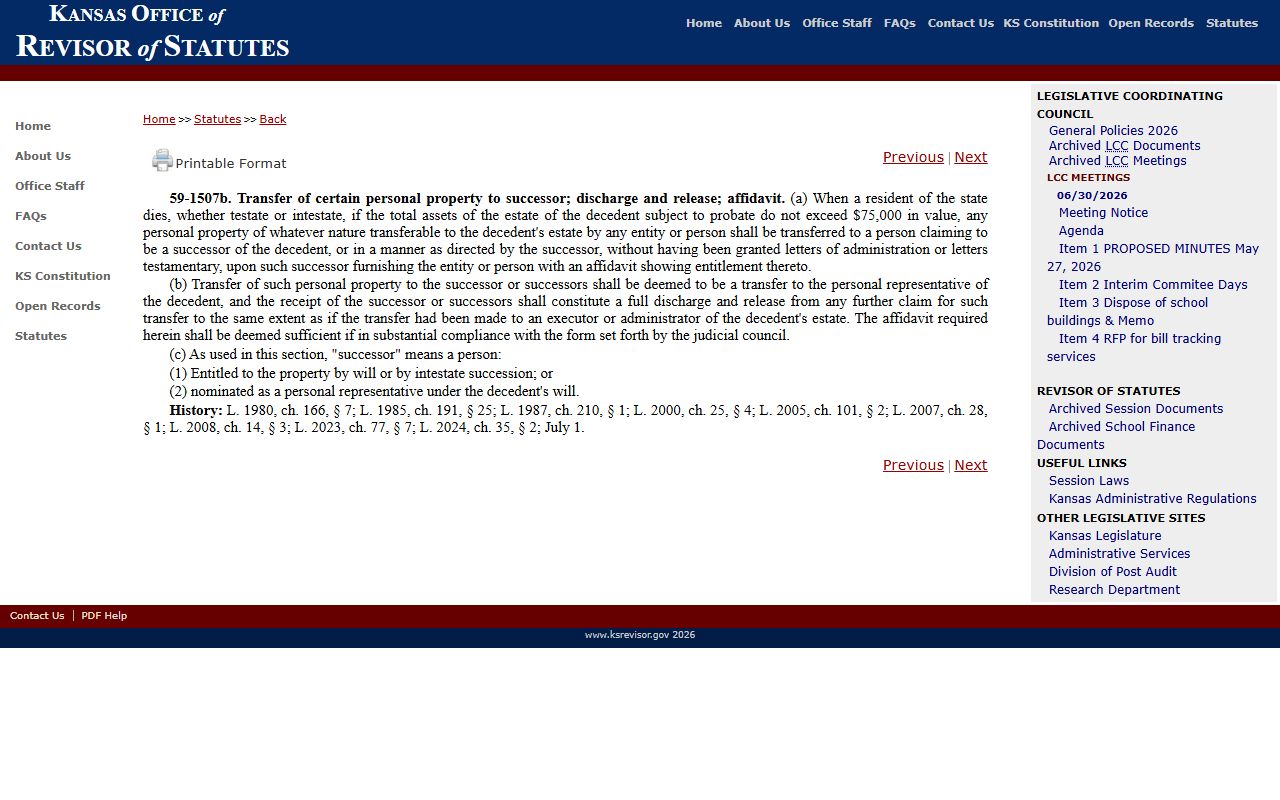
That statute matters because qualifying small estates may use an affidavit route instead of a full estate administration case in Brown County District Court.
Brown County Probate Terms
Probate records use terms that do not always match everyday language. A will case may name one role, an intestate estate another, and a guardianship or conservatorship yet another. These terms help identify the right Brown County probate record and prevent a request for the wrong file.
- Testator
- The person who made a will before death.
- Executor
- The person named in a will to carry out estate duties after appointment by the court.
- Intestate
- A death without a valid will, so Kansas succession law guides who may inherit.
- Administrator
- A person appointed to manage an estate when no executor is named or able to serve.
- Guardianship
- Court authority over personal decisions for a minor or incapacitated adult.
- Conservatorship
- Court authority over money or property for a protected person.
Brown County Probate File Contents
A Brown County probate case file can be thin or extensive. A simple estate may show a petition, notice, appointment order, letters, inventory, claims, and final decree. A contested estate can include objections, motions, hearing notices, sale orders, creditor disputes, accountings, and orders that explain how property is administered. Guardianship and conservatorship records may include petitions, bonds, inventories, medical or financial reports, annual accountings, and orders about a protected person.
| Field | What It Shows |
|---|---|
| Decedent or protected person | Name of the estate subject, minor, or protected adult. |
| Case number | District Court number used for CaseSearch, clerk lookup, and copy requests. |
| Petitioner | Person asking for probate, administration, guardianship, or conservatorship authority. |
| Personal representative | Executor, administrator, guardian, or conservator if appointed. |
| Orders | Admission of will, letters, sale authority, final settlement, or protected-person orders. |
| Inventory and accounting | Estate property, financial activity, or reports that may be partly restricted. |
Brown County Small Estates
K.S.A. 59-1507b allows certain Kansas personal property transfers by affidavit when the total probate assets do not exceed $75,000. The affidavit must show that the successor is entitled to the property. The statute recognizes successors by will, intestate succession, or nomination as personal representative. Research users should treat this as a record-access issue as well as an estate issue: if the small-estate affidavit route was used, there may be less court-file material than a formal probate case would create.
The Kansas Judicial Council publishes legal form categories for probate and small-estate affidavits. The 22nd Judicial District also links statewide court forms and court resources. Forms can help identify what information the court expects, but contested estates, real estate transfers, unclear heirs, and guardianship disputes often need legal advice. Brown County court staff can give filing and copy information, but they cannot act as a lawyer for the estate.
Brown County Probate Copy Fees
The research file did not locate a current Brown County probate filing-fee schedule published by the local court. Published local fee details are narrow and should not be stretched beyond their source. The Brown County genealogy packet lists historical or genealogy copy pricing for District Court records, and the county open-records form lists administrative KORA copy fees. Current certified probate copies should be verified with the Clerk of the District Court before mailing payment.
| Record or Service | Amount Found in Research | Use Caution |
|---|---|---|
| District Court genealogy copy | $0.50 per copy | Genealogy packet context, not a current certified-copy guarantee. |
| District Court genealogy certified copy | $1.50 per certified copy | Verify with the Clerk of the District Court for current probate copy needs. |
| Brown County KORA copy | $0.30 per page | County administrative records, not a substitute for court-record procedures. |
| Research or compiling | Employee hourly rate, one-hour minimum | Listed on county open-records form for county records. |
Note: Filing fees and certified-copy fees can change, so confirm the amount before sending a probate request by mail.
Older Brown County Probate Records
Brown County has unusually useful local history sources for older court and probate research. The county genealogy packet says the Clerk of District Court has probate and court records, marriage records from 1857 to present, and naturalization records starting in the 1930s. It also points researchers to local libraries, the Brown County Genealogical Society, the Brown County Historical Society Downtown Museum, the Ag Museum, and library microfilm resources.
Older probate files may not appear in modern online systems with the same level of detail as recent eCourt cases. A family-history search may need a mix of courthouse records, local archive indexes, cemetery records, newspaper notices, land records, and historical society holdings. The Register of Deeds holds land records from 1857 to present, which can matter when an estate involved real property.
Restricted Brown County Probate Details
Not every Brown County probate document is open in the same way. Kansas public access favors public records, but K.S.A. 45-221 lists records that are not required to be disclosed, and Rule 22 controls electronic court access. Guardianship, conservatorship, medical, minor, adoption, mental-health, sealed, and protected financial details may be withheld, redacted, or available only to authorized parties.
For a public estate file, the docket and many orders may be available through CaseSearch, a courthouse terminal, or clerk assistance. For a protected-person matter, the safer route is to ask the Brown County Clerk of the District Court what can be released and what proof of authority is required. That keeps the request tied to Kansas court access rules rather than a broad county open-records request meant for administrative records.