
Brown County Criminal Court Records
A criminal court record is the court's file for a prosecution. In Brown County, state-law criminal cases are handled in Brown County District Court, part of the 22nd Judicial District at the Brown County Courthouse. The file may begin with a complaint or information, then add bond orders, first appearance or arraignment entries, plea records, motions, hearing notices, warrants, sentencing journal entries, probation terms, revocation filings, and disposition data. Peggy Siebenmorgen, Clerk of the District Court, is the local court-records contact for District Court case files and certified court copies.
Municipal courts can handle city ordinance and city traffic violations. Those matters are not always in the same channel as District Court criminal cases. Horton Municipal Court is one official local example. Felonies, many misdemeanors, probation violations tied to District Court, and serious state-law criminal matters belong in District Court. A person researching the arrest-to-charge path can use the separate Brown County arrest records and court charges page for the charge list itself, while this page stays focused on the full court case file and outcome.
Search Brown County Criminal Court Records
Use Kansas CaseSearch first for public District Court criminal case information. Search by case number when possible, then by defendant name. Brown County warrant data shows examples of CR and TR style numbers, including 2025CR155 and older formats such as 99CR151. CaseSearch may also support party name, business name, citation, and role-based criteria. Public users should expect limits when a document is sealed, confidential, or restricted from remote display.
- Search Kansas CaseSearch by Brown County criminal case number if the number is known.
- Use defendant name search when the case number is not available.
- Confirm the court is Brown County District Court or another correct court level.
- Open the case information and read the docket entries in date order.
- Look for filed charges, plea, disposition, sentencing, warrant, and probation entries.
- Contact the Brown County Clerk of the District Court for certified copies or public records that are not available remotely.
The Kansas expungement statute appears in this image from K.S.A. 21-6614.
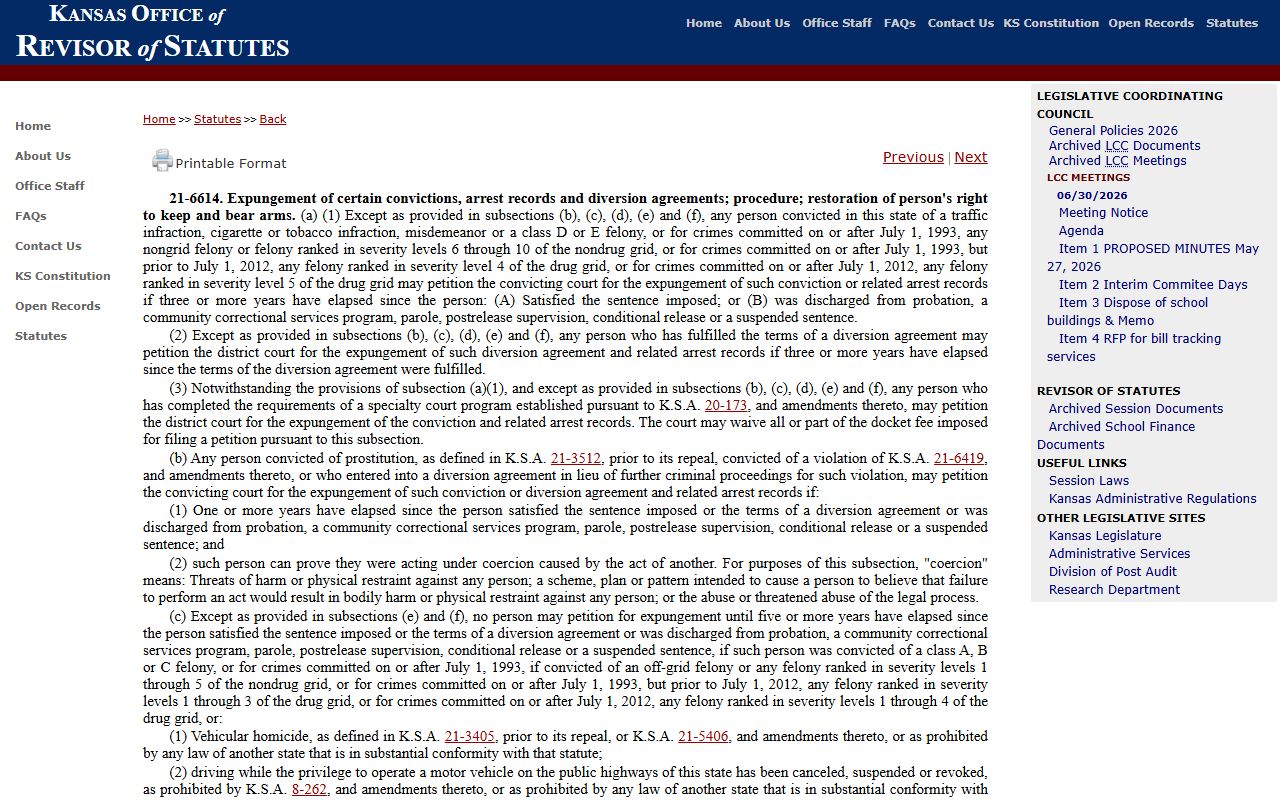
Expungement law matters to criminal court records because an eligible record may later have public access limited by court order.
Brown County Criminal Case Flow
A Brown County criminal court record is easiest to read as a sequence. The charge may start with an arrest or summons, but the court record becomes meaningful when a charging document is filed and the case begins moving through District Court. Not every case goes to trial. Many cases end through dismissal, plea, diversion, probation, sentencing, or another disposition.
Case flow: Charges Filed › Arraignment › Pretrial and Motions › Plea or Trial › Disposition › Sentencing
| Stage | What Happens |
|---|---|
| Charges filed | The County Attorney or prosecutor files the criminal allegations through a complaint or information. |
| Arraignment | The defendant is advised of charges and a plea may be entered. |
| Pretrial / motions | The court records hearings, continuances, motions, discovery issues, bond changes, and warrants if a person fails to appear. |
| Plea or trial | The case moves toward a guilty plea, no-contest plea, trial, dismissal, or other resolution. |
| Disposition | The court records the outcome for each charge or count. |
| Sentencing | The record may show jail, prison, probation, fines, restitution, costs, treatment, or other orders. |
What Brown County Criminal Records Show
Criminal court records combine identity, charge, docket, and outcome information. The record may include Kansas statute numbers, count numbers, charge text, bond entries, warrants, plea dates, motion activity, hearing dates, disposition, sentence, probation terms, revocation filings, and financial obligations. Brown County sheriff warrant and jail data show local charges such as failure to appear, probation violation, disorderly conduct, criminal threat, traffic offenses, and marijuana or paraphernalia charges, but the filed court record is the source for case outcome.
| Field | What It Shows |
|---|---|
| Case number | The District Court tracking number, often with criminal or traffic-style prefixes in local examples. |
| Defendant | The person charged in the case, with public identity data subject to redaction rules. |
| Charges | The filed allegations, statute numbers, count numbers, and any later amendments or dismissals. |
| Docket entries | Hearings, motions, orders, continuances, warrants, pleas, sentencing, payments, and probation events. |
| Plea | Guilty, not guilty, no contest, or other plea activity when entered and public. |
| Disposition | The result of each case or count, such as guilty, dismissed, acquitted, diversion, or another outcome. |
| Sentence | Probation, jail, prison, fines, costs, restitution, treatment conditions, or revocation orders when applicable. |
| Documents | Public complaints, orders, journal entries, and other documents when remote or terminal access is allowed. |
The KBI registered offender registry is shown in this image from the Kansas Bureau of Investigation registry access page.
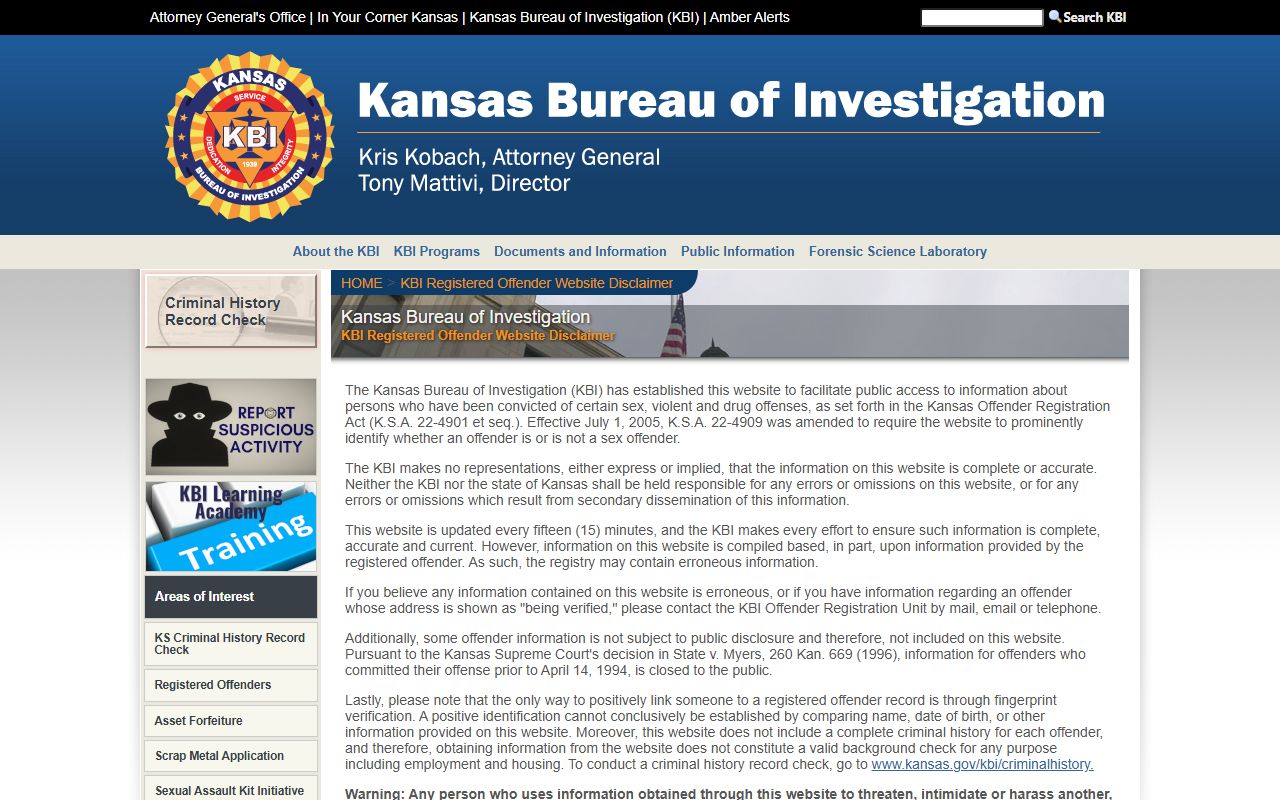
The registry is separate from a Brown County criminal court record and should not be treated as the court case file.
Charges vs Convictions
Being charged is not the same as being convicted. A Brown County criminal court record can show charges that were later dismissed, reduced, amended, resolved by plea, resolved by trial, or tied to diversion. The docket should be read through the final disposition, not stopped at the first charge entry. This is especially important when a jail roster or warrant list shows a booking charge before the court case has reached an outcome.
| Point | Charge | Conviction |
|---|---|---|
| Meaning | An allegation filed or lodged after arrest or summons. | A final guilty finding or accepted plea on a charge. |
| Record stage | Early or pending stage of the case. | Disposition and sentencing stage. |
| Can change | May be amended, reduced, added, or dismissed. | May be appealed, corrected, revoked, or later expunged if eligible. |
| How to read | Check each count and later docket entries. | Confirm the final disposition and sentence. |
Brown County Dispositions and Sentences
A disposition is the outcome of a case or charge. In criminal records, the disposition can be guilty, dismissed, acquitted, diversion, amended to a different count, or another court-entered result. A sentence is the court's order after conviction or plea. It may include probation, jail, prison, fines, costs, restitution, treatment terms, no-contact orders, or other conditions. Probation violation entries may appear later if the court alleges noncompliance.
Brown County researchers should separate the case result from jail custody status. A person can be in jail before conviction, released on bond, sentenced locally, placed on probation, or moved into the Kansas Department of Corrections system after sentencing. KDOC's KASPER tool is for state prison and supervision records, not the District Court case file.
The KDOC search disclaimer appears in this image from the KDOC KASPER offender search.
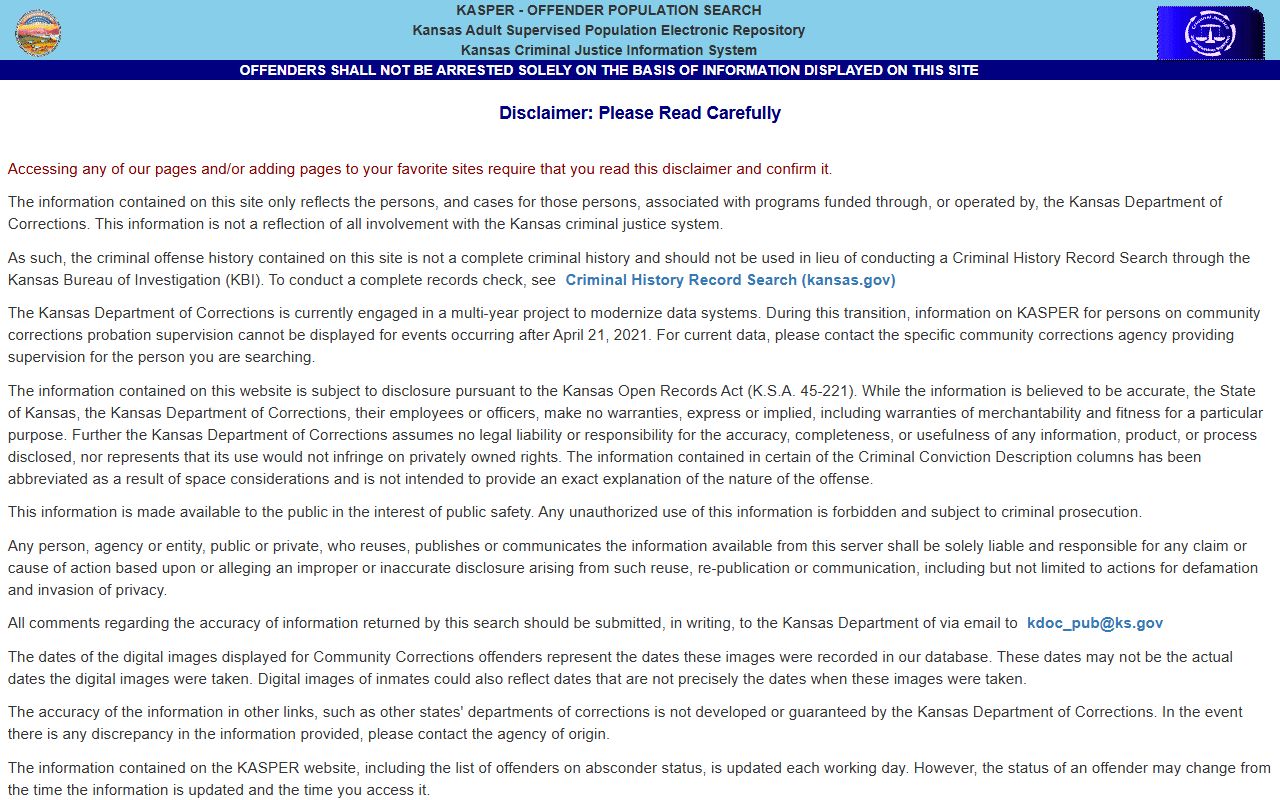
KDOC can help with sentenced custody or supervision, but Brown County District Court remains the case-record source.
Sealed vs Expunged Records
Sealed and expunged records both limit public access, but they are not the same thing. Kansas court guidance states sealed cases and sealed records are not available through public portal or courthouse terminal access. Expungement under K.S.A. 21-6614 can limit public access to eligible convictions, arrest records, and diversion agreements after a petition and court order. Eligibility is offense-specific and time-specific.
| Point | Sealed | Expunged |
|---|---|---|
| Public visibility | Hidden from ordinary public access while the seal applies. | Public access is limited after a court grants expungement. |
| How it happens | By court rule, statute, or judge's order. | Usually by petition in the court where the case exists. |
| Examples | Sealed filings, protected attachments, or confidential case categories. | Eligible adult convictions, arrests, or diversions under Kansas law. |
| Limits | Some agencies or parties may still have access. | Does not erase the event for every government or legal purpose. |
Access Brown County Criminal Records
Criminal court records are court records first. Use Kansas CaseSearch, courthouse terminals, and the Brown County Clerk of the District Court for public District Court case data. Kansas Supreme Court Rule 22 controls public electronic access to district and appellate case records. The Kansas Open Records Act, including K.S.A. 45-216 through 45-223, is more relevant to county administrative records and agency requests.
Several related systems answer different questions. The Brown County Sheriff's warrant list shows active warrant information, and Sheriff John Merchant's jail roster shows current booking and custody fields. KBI registry records are registered-offender records, not a full criminal-history report or a court file. KDOC KASPER shows state prison and supervision information, not the Brown County District Court docket. Mixing those systems can lead to wrong conclusions about the status of a charge or sentence.
Note: Always read the final disposition before treating a filed charge as the case outcome.
Restricted Brown County Criminal Records
Juvenile offender records, child-in-need-of-care matters, adoption records, care-and-treatment cases, sealed records, and confidential documents are not ordinary public criminal court records. Redactions may also remove Social Security numbers, protected addresses, financial account data, minor names, and sensitive attachments. If a search result is missing or incomplete, it may be restricted rather than nonexistent.
No Brown County-specific public defender office page was located in the official research. A person seeking appointed counsel generally asks the court at first appearance or files required financial affidavit or indigency paperwork. Criminal defense questions, expungement eligibility, and warrant-risk questions should be handled through an attorney or the court process, not by guessing from a public search screen.